Sunday, October 21, 2012

Cancelled Before Prime Time: Xenogears/Xenosaga

In my last article, five projects I wish I could have worked on, I placed Xenogears at #1.  Xenogears was a video-game, not a book or a TV show or magazine.  I suppose I could have placed it at #2 and put The Economist, a British newspaper, as #1; but that weekly publication is ongoing and going strong, and maybe some day I will be worthy of such an honor.  The point of the list was to mention series or shows that were no longer being produced, or were probably going to be full-up on staff for a long time.

It's only fitting that I make Xenogears, a Playstation One game by Squaresoft released in America in 1998, and it's "spiritual successor" trilogy Xenosaga, the next subject of my own little series, the one you're reading now!
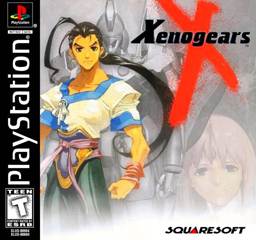
Xenogears; Image via Wikipedia, copyright Squaresoft


Xenogears:  Stand Tall And Shake The Heavens

As I said in my previous article, Xenogears is a very complicated game.  Spoiler alert - it involves reincarnation, psychological melodrama, and the reinterpretation of the Bible in order to create a new mythology.  Giant robots called Gears fight one another, always a pleasure.  The primary character, Fei Fong Wong, is an amnesiac who has lived in a peaceful little village for three years; a village which so far has been spared the fall-out from a war between two nearby nations.

Since this is a Squaresoft game from the PS1 era, you probably already know the village is doomed.

The long and short of it is that Fei is a destined figure, existing more or less at the whim of some supernatural fourth-dimensional power called Zohar, which has been shackled by ancient peoples to power a super-weapon, Deus.  I wouldn't spoil the nature of those ancient peoples, but the game'll do that within the first anime sequence, so I'll make it simple - it's aliens, humans from another world.  Deus is evil and it's keeping Zohar imprisoned - not to mention messing with humankind as a whole.  So, Fei's job is to kill that super-weapon, this world's version of "God," thus freeing this "wave existence," and generally liberating the world from it's heritage.

It sounds like your standard cliche set-up of destroying the bad guy to save everyone, but what made Xenogears awesome was the way it was written.  Ten thousand years of history are brought up in this world's final battle against Deus.  Multiple lifetimes culminate in this one final show-down.  The second half of the game plays in some ways similar to a novel, with exposition (occasionally too heavy to bear, but we'll get to why) replacing the usual monotony of "Buy gear, explore dungeon, find better gear, fight boss, dialogue, buy more gear" that roleplaying-games take.

The biggest problem with Xenogears, also as I mentioned, was that it's final production was rushed - especially with regards to its conversion into English.  People have surfed through the data and found plenty of incomplete scenes, and a follow-up book called Xenogears:  Perfect Works has a full explanation of what exactly Xenogears is about.  As a result, the later half of the game is a bit awkward, with some confusing changes-of-scenery that can be irksome primarily because they aren't well executed.

One final issue of curiosity is that, as expansive as Xenogears itself is, it is described in a very Star Wars manner as "episode five", of six.  That's right - a 40+ hour game is only one part of a six part story, and interestingly enough it's the second-to-last one.

And that brings us to...


Xenosaga:  Follow-Up To A Cult Classic

Before any follow-up plans could be executed, the creator of Xenogears (who'd worked on a number of Final Fantasy games, to boot), Tetsuya Takahashi, left Squaresoft and found his way to Namco's doorstep.  He got authorization, under his own sub-company called Monolith Soft, to create Xenosaga, a Playstation Two game series which served as a "spiritual successor" to Xenogears.  Episode One was set well after the discovery of the Zohar on Earth, which by the way has long since been ditched.  Mankind has built an interstellar empire.  Nanotechnology, giant robots (similar to the Gears from Xenogears), android and starships abound.  Rebels fight federal forces - it sounds a little cliche, to start!  If that sounds familiar, it's because Xenogears starts off that way, too!

At the onset of Episode One, however, humanity faces a crisis. Aliens called Gnosis are invading, and they are not to be trifled with.  They're ethereal, for lack of a better term, and it takes special technology to even be able to interact with them.  As the plot progresses, all sorts of conspiracies are unearthed.  The Zohar is fought over by some, while it's destiny is explored by others.  Three episodes were made, and unlike Xenogears the three games were chronologically condensed - characters from the first are alive during the third.  The series was planned to run for six episodes, but halfway through it got the axe.

I have to admit, I'm part of the problem here; I played Xenosaga:  Episode One, and I believe I've played a bit of Episode Two as well.  I've never played Episode Three, and as we know, low sales can lead to series cancellations.  Others chalk this collapse up to internal collapse; Takahashi and others either changed their level of involvement, or left the project before its completion.  With the old links to Xenogears drying up, Namco called it quits; eventually it sold its stake in Monolith Soft to Nintendo.

However, I feel like Xenosaga ran into a second problem, one that I don't think any amount of sales were going to solve:  Xenosaga was Episodes 1, 2, and 3.  Xenogears is Episode 5.  What would Episode 4 and Episode 6 be?  As it was only a "spiritual successor," would Xenogears be essentially re-made and re-written?  Most importantly, how quickly would Squaresoft sue?  After all, it held the rights to Episode 5, or at least what we figured Episode Five to be.  So what would happen?


The Fate of the Xeno-Games

I love playing little fantasies out.

Well, Episode Three apparently leaves off with the characters searching for Earth.  I can imagine Episode Four as a relatively simple sketch; Zohar is harnessed, and ultimately the characters attempt to stop Deus from being constructed.  They fail, because they have to, and they fight to save their world by shipping Deus off.

Episode Five is Xenogears.  It isn't changed, although if it were possible it'd be awesome for it to be cleaned up and re-released.

Xenosaga Six, however, is what's interesting.  I'd like to give a little shine to one person's project; Bobbincranbud created "Xenogears:  After The Fall," a serialized "after-the-end" that really helped shape my early writing career.  It's fascinating, but it doesn't serve as much of a conclusion for what Xenosaga ultimately became - an interplanetary, interdimensional conflict.  Xenogears, after all, comes off as more of an explanation of what happened to Zohar and how it finally sought to achieve liberation.

What about the rest of the universe, the one that Deus bailed on ten thousand years ago?  Was the liberated Zohar the only one of it's kind?  Well, we know there are "emulators" that are tied into it - was Deus' just one of those, or was it the real deal?

I suppose I envision a sixth game wherein the humans who survived Xenogears have rebuilt their world and, eventually, make contact with the humans that originally sent Deus away.  The Gnosis still exist, after all, and while Deus was clearly designed to fight against a superior foe (say, aliens that are very hard to injure without special powers?), it ultimately was only one project.

Will we ever find out what Takahashi and the series' creators wanted?  Probably not.  Despite the title, Takahashi's latest work, "Xenoblade Chronicles," isn't tied into the Xenogears/Saga world.  Namco no longer owns the rights to Xenosaga, and Squaresoft only has the rights to Xenogears.  Nintendo is far from the boat-shaker that is required to produce such cerebral works.  They make great Mario games, but they're the last people I'd imagine raising Biblical allegories and committing what some might consider to be sacrilege.

Whatever the case, it's a truly tragic loss that neither one of the original visions (Xenogears Episode 1-4, 6; or Xenosaga 4-6) were completed.  And there's always hope - after all, Xenoblade Chronicles required a lot of effort to be ported over to America, and Operation:  Rainfall succeeded, so you never know...

Tuesday, October 16, 2012

Five Projects I Wish I'd Worked On

As a writer, there's plenty of opportunity in the world.  Sometimes, however, you don't get to work on the very best creative projects you will ever see.  Others, you just aren't old enough; other times, you aren't known enough.  Finally, a lot of times those projects come to an end at some point before they even get started - they had potential, but they just drifted away.

Here are five projects, heavy-in-writing, that I wish I had been able to work on.


#5:  Undergrads

Sitcomsonline.com


I've talked about Undergrads before, so fully detailing that series would be a grievous misuse of my powers. Which are writing, and writing.  Now, I've mentioned how the show was forced to be non-edgy out of the fear of censorship and all that, whereas real college life is nothing but that edge.  How would I have changed things?  No idea.  I would definitely have been a force for it's edginess, to keep recycling a word, and I would have thought about taking the Arrested Development approach of cleverness and double/triple meanings - though that would be risky, as the target audience for the show was too young to really get such jokes.

Nevertheless, not only was the series a very small project (without a large need for external writers), but it was too short lived and before my time.

Speaking of...


#4:  Arrested Development

Another series I've talked about!  What are the odds?

geektyrant.com


Here's the thing that made Arrested Development so awesome:  Its humor was character driven, but also driven by the writers' distinct ability to talk about absolutely and totally forbidden topics on a major prime-time network...And get away with it.  They did this through both blunt-but-not-over reaching jokes, like how Tobias is an Analyst + Therapist.  Making him an Analrapist.  Then there's more subtle times, like when Tobias believes his children are heavily into leather clothing, so he goes to a store and asks if there's anything that would make him a "Leather Daddy."

Insert every "Tobias Is Gay" joke out there.

Working on Arrested would have been awesome.  Considering it's coming back, well, there -is- a very minor chance I'll get on it!  Unfortunately, they're already filming, so it'd have to involve a time machine.


#3:  Moral Orel

AOLtv


Moral Orel is just one of those shows waiting to have a "Cancelled Before Prime Time" article.  It's the first of two Adult Swim shows on this list, surprise surprise, and why is Orel on here?

Because Orel is about as gritty a drama as you can get in the world of Claymation, with dark humor and serious social commentary all wrapped into one.  Robot Chicken, similar in visual style, is much more light-hearted, and considering the number of gruesome deaths on that show?  That's saying something.  Moral Orel doesn't need death to be bleak.

The upshot is that there is apparently a made-for-TV movie in the works for Moral Orel, but its cancellation after three seasons (with the absolutely depressing trimming of the final season, to boot) just served as an honestly crushing blow.  So, chances are, I'm not workin' on this, either.  But let me tell you - if you haven't, you need to watch Season 3.  Shortened as it is, it's one of the finest seasons of TV I've ever seen in any medium, ever.


#2:  The Venture Brothers

Okay.  This one...Is probably the only one I'd ever have any shot of getting in, mainly because it's the only one still being actively, aggressively produced.  Unfortunately, it's also way too high profile for a TV newbie like me!

Sharetv.org


Where do I really begin?  Well, with it's beginning.  Venture Brothers really started as sort of a spoof show, a parody of the old Johnny Quest TV show.  As it grew into its own production halfway through the first season, however, character complexity took center stage.  No longer was it just about whatever random adventure Rusty happened to be on; it became about the state of The Monarch's relationship with Dr.  Girlfriend.  It became about Hank and Dean growing up and, in time, becoming more than just tag-along nuisances.

It became its own show.

With this Adult Swim show having suffered from production troubles due to a company going under, the stage is quickly being set for a fifth series.  It will be awesome, because it's production is in the hands of people who truly care about it.


#1:  Xenogears

Oh yes, I said it.  A video game.  Not a TV show, not a comic book, not a novel project; a Playstation One game.  And I'm going to show the very first scene which will explain why...

Joystiq.com

In case you're wondering, yes; this game very nearly got banned from the United States for scenes like that one.  It's plot is somewhere between a scathing Biblical launch-point, an episode of Mobile Suit Gundam, a Final Fantasy game (It's made by Square), and an awesome psychology lesson.  I don't want to spoil things because, frankly, the game'll do that in due time if you can pick up a copy, but here are some highlights...

 - Umpteen years ago, a space-craft crashed on Earth.
 - Your protagonist pilots a giant robot of destruction.
 - Battles between sand-submarines.
 - UFOs.
 - Religious iconography that's powerful and creative.

The biggest weakness Xenogears had was that it didn't get perfectly translated when it came to the U.S..  That, and sometimes dungeons can get a bit long-in-the-tooth, with old-school random encounters that today seem to only get in the way of a story...Except that typical RPGs of today are nothing but story broken up by bits of tutorial mode.

I would have loved to work on this project, if for no other reason than to provide an extra degree of precision on the final product.  Any translation runs some risks, but Xenogears - with its dialogue-heavy plot - ended up very well, despite not attaining perfection.

Oh well.  That's what Perfect Works is for.

Friday, September 28, 2012

How To Use Verbs; Verbing; Verbosity

This is a problem that comes often when someone is writing:  There's an action going on in whatever it is that's on paper, and you (the author) have no idea how to explain it.  For example, your protagonist is going out to Mc'Donalds, but you've already used that phrase twice.  Repetition can be a serious problem in a story, so you need a better way for them to explain their plan to their friends, other than "Going out to McDonalds."

"I'm on a McRun," the hero says, dashing off to get his fries.

A second character responds, "Wait!  What's McRunning?!"

And you, the author, are left saying, "Huh."

Verbs, as we should know through reading my old Parts of Speech Infographic, are "action words."  They describe what people, characters, what-have-you are doing.  "Drive" is a popular example.  "Describe" could be another.  These are things that we do.  But using them in an appropriate, effective manner is another story entirely.

Sometimes, a verb can stand alone.  "Running" can serve as a classification of a hobby; people like "running," and regularly use it as a Google search.  Sometimes you just need to use good adverbs.  Adverbs are words used to better describe a verb.  Let's take, as a simple example, "He drove expertly."

"He" is a noun; "drove" is the past-tense of "drive," so it's our verb in this short sentence; "expertly" describes how this random guy drives.  A reader will know, therefore, that "he" is an expert driver.  Of course, you could nit-pick something this isolated-in-the-void (void-dwelling, perhaps?) down - "He drove expertly" implies that in at least one incident, said "he" happened to indeed seem like an amazing wheelman, but that this past incident might well have been a lucky shot and...

...Wait, what just happened?  I just found another way to explain "he drove expertly," while simultaneously mocking that very phrase!  Words are like that; they have connotations as well as denotations - they have interpreted meanings which can differ from their literal ones.  A "Wheel Man" sounds like a beast from a video game; a "wheelman" is an ace driver.  Of course, the term "wheelman" is also often used in crime stories, to refer to the guy who drives the vehicle and must, therefore, drive expertly.  And in-so-far as being something can be being that verb, being a "wheelman" is something you always are; "wheelmanning," or "manning the wheel" is what you sometimes do...

Maybe we need another example.


Let's look at "Blogger."

A "Blogger" is someone who "Blogs."  A "Blog" is...Well, this is a blog, but that doesn't explain much!  This is more like a place for some crazy word-ninja to write down random ideas at 11:00 PM!  In all seriousness, though, a "blog" is basically a journal where an author writes up and distributes articles.  With me so far?  And I have no idea how the word "blog" got started - I'm sure there's a good reason, I just don't know it off-hand and I don't feel like researching it.  Call me lazy.

What I do know is that the authors of a "Blog" were immediately "verbed," with their writing suddenly referred to as "Blogging."  "Bloggers" was a natural evolution; it's simply someone who "Blogs," which is the act of "Blogging."  But if you look wayyyy up at the top of your address bar, you'll notice that this website is a .blogspot website - a spot for blogs, right?  Yes - and no!  For "Blogspot" is actually a Google-owned sub-company called "Blogger."

I am, now, a blogger.  I write blog posts.  I write entire blogs!  Yet I am not Blogger, the service.

You will notice, by now, that I seem to be going off on tangents a lot.  You might even have noticed that this blog entry's title begins with "How To Use Verbs."  It does not say the following...


How to Use Verbs Effectively

The reason why I've waited until now to "get serious" is that, frankly, writing is about timing.  The first thing this rule implies is that everyone has their own timing; when timing differs between writer and reader, there can be a dissonance which can make the writer's work hard to read - if not render it altogether intolerable!

More importantly, however, is the fact that timing means knowing which verb to use, when, and how.  A lot of times this is simply technical; to write, as a sentence, "Next, the computer activated" is entirely mysterious. Does the computer activate on its own?  How?  Is it artificially intelligent?  It's just a lot of questions, and if there aren't any immediate answers, readers will start to sense that aforementioned dissonance.  They will get lost.  Instead...

"Next, Bob activated the computer."  Now we know that Bob is involved in this picture, and that he activated the computer.  Suddenly a reader has an idea of what's going on.  But how did Bob activate it?  Did he just tap an on switch?  Or, like a movie hero, did he turn it on with his mind?  Maybe that sentence needs a little more work.  Let's step up our game!

"Next, Bob knelt down and plugged in the old computer tower; it roared to life, courtesy of its creaky fans which discourteously spat dust back into Bob's face."

Wow.  So now we have a real clear picture of this Bob Plus Computer shindig.  His motivations are unclear, and while one might make inferences (he's searching for an ancient file!), that's for another sentence to explain.  From what's written in this example, you can see that by sprucing up the diction (word-choice) and adding a hint of complexity, we've actually taken a lot of the guess-work out of what's going on.  We know that Bob plugged in the computer.  We know its old.  We know Bob physically had to do things, and we know Bob isn't gonna be happy about all that dust in his face.

All in all, I only wrote this article because I was curious what my take on an article about verbs would be.  I've never really written one before, and here we have it!  It's not scholarly, it's hardly serious, but it has a point it's trying to get across.  Hopefully you'll agree that a point was made.

Shameless self-promotion

And, hey, if you like my style, buy my book!

Saturday, September 15, 2012

Cancelled Before Prime Time: Firefly

Welcome to our third installment of the "Cancelled Before Prime Time" series!  As I mentioned previously, Summer Glau has an unfortunate lot in life; she's talented, but when she pops up in a show it tends to go the way of the dodo.  I felt it only fitting to explore the first of many such series - Firefly!


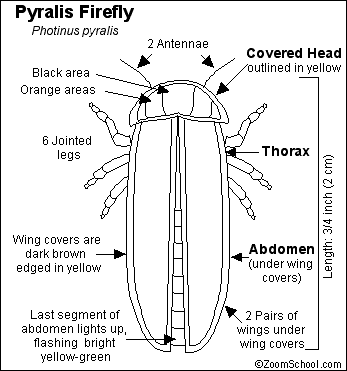
Image from Enchantedlearning.com

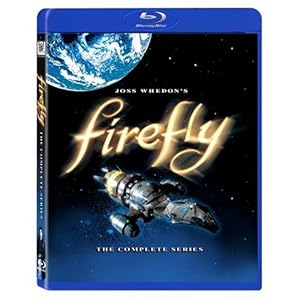
No!  Not that firefly!  This firefly!

Image from Amazon.com


Firefly debuted on Fox on September 20th.  It lasted until December 20th.  That's right, folks - Firefly only had a grand total of fourteen episodes produced.  Not all of them aired.  But enough spouting on about the Wikipedia article's bottom-of-the-barrel facts, lets...Yammer on about more facts, actually.

Joss Whedon.  There, I've said it.  This man has serious hit-or-miss potential.  In the late nineties he created a tiny little movie-and-TV-show called Buffy the Vampire Slayer.  Y'might have heard of it.  It had a spinoff series as well as an "expanded universe," I.E. comics and the like.  No big deal, right?  Well, here's the trick: Whedon's huge hits have always been betrayed by his, ahhh, smaller ones.  Firefly?  Smaller one.  Oh, it's a really good series!  But it's not Buffy.  Dollhouse is one of his most recent TV productions, and it didn't do so great (it also had some Summer Glau in it), but what came right after that?  The Avengers, that's what.

So Whedon goes from up to down faster than a manic depressive switching off between methamphetamines and booze.  And that'll be our offensive joke quota for this section of this article.  Let's look at character development.


The Souls Aboard the Serenity

In a startling departure from the ordinary "Name your series after a character or object in it" policy, Firefly is not the name of the starship carrying our protagonists around.  It's just the model; the actual vessel is called Serenity, and it's named (of course!) after a battle that our hero, Malcolm Reynolds (played by the Nathan Fillion) fought in and lost.

Serenity isn't a warship like the Death Star or a peaceful-but-deadly vessel like the Enterprise.  It's a small but resilient little transport ship.  That'd be fine enough, but it's inhabitants take Serenity on all sorts of crazy adventures.  There's an overarching space empire called The Alliance, which Mal's side fought against and lost to, and their grasp on their frontier territory is, well, exactly as great as a historian would imagine it to be.  There's also weird, half-legendary half-people called Reavers, who are crazy and barbaric and so therefore terrorize the fringes of Alliance space.  See:  The Native Americans (not the real ones, of course, but the mythical version).  So the Serenity's staff zips across the galaxy and transports priests as well as illegal contraband.

Malcolm himself is the heart-and-soul of his ship.  He's incredibly loyal to his friends, an unusual trait among outlaws but one that keeps Serenity's crew from dying, like, every episode.  There's Kaylee, a nice girl who is cute, quirky, and in charge of keeping the ship's engines running.  You've got your stoic second-in-command Zoe, a soldier who fought under Mal's command; she's married to Wash, your kooky pilot who fears the relationship the two old friends have...Waiiiitttt!  Why am I starting to sense stereotyped characters, here?  It's almost as if this is a spaghetti western!  Next you'll be telling me there's a priest who happens to have awesome skills with a gun and...

Image courtesy of Animecrazy.net


...No!  Not him!    There is, however, Shepard Book; one of my favorite characters, he's a man who clearly has a history with the Alliance but has renounced his old life in favor of peace...Save that he's trapped in Serenity's hi-jinx and, furthermore, that we never get a really good explanation of what that past is.

See, this is the problem Firefly might have come across.  Many of its characters were reincarnations of old western themes with a space-faring twist on them, and that's great!  Hell, I genuinely loved many of the characters who fit those very stereotypes!  But it might have led to some viewers tuning out, saying "I've already seen this flick, only with horses," and moving on.

Where Firefly really broke with tradition was with the Tams.  Simon is a mild-mannered medical-genius prototype, just innocuously impressive enough to have a nasty little backstory all to himself.  It's revealed in episode one, when he's found to be carrying around a rather naked Summer Glau - his sister, River.  She's your "crazy, broken girl psychic" character, which I don't really remember being anywhere in the old westerns.  Anyway, she's a secret Alliance weapon of dubious nature, and her presence is a constant thorn in Mal's side.

There's also Jayne, the mercenary; Inara, the companion; "Saffron," a con artist who marries her marks, and other characters who are all awesome in their own rights, but not exactly the most original characters on the block.


Where Firefly Fell, Serenity Soared

As I mentioned earlier, maybe it was just that it felt like a rehash of a western to some people, but Firefly wasn't all that successful.  For a major network like Fox (who, you'll see, is a recurring villain in my series on cancelled projects), an average of 4.7 million viewers per episode just wasn't enough.  It got the 'ol axe. This didn't make those, y'know, millions of fans very happy - they launched all sorts of crusades.

In 2005, to shut up the aforementioned fans, a movie was slapped together, fittingly enough called "Serenity."  It's box office just about made back it's costs-of-production, while Node 3 of the International Space Station was almost named "Serenity," probably after this series.  Of course, the official poll was discarded and the name "Colbert" almost won it as well, so maybe that's not such a great sign to look toward...

...Anyway!  Serenity sold well enough to break even, but that doesn't get movie sequels.  On the other hand, there's a whole expanded universe - comics, novels, and even a roleplaying game!  For hardcore fans, some of these products might well be worth looking into, as might the fan-created sequel, Browncoats:  Redemption.

When it comes to an autopsy, however, there's really no reason at all why Firefly died; other than, perhaps, due to low ratings.  It's story was largely unexplored, but with eleven aired episodes (and fourteen produced, including one of it's best), the fact is that the series was never even given a chance.  4.7 million viewers really isn't that bad an average; but ten years ago "Reality TV" was starting to make it big, and perhaps that's the greatest lesson to be drawn from Firefly:

Great writing and development are little match for low-cost production.


Shameless Self-Promotion!

Wow.  That doesn't speak well for my chances as a writer; but, hey, you could always check out my latest novel and see if ya like it!

Saturday, September 1, 2012

Cancelled Before Prime Time: City of Heroes

Y'know how sometimes you come up with plans to write about certain topics?  Like, how there's not one but two Summer Glau series which I could explore in this column?  Oh yeah.  There's an NBC series that relates to the subject that's now pre-empting the aforementioned Summer Glauness, however.

Because this weekend, much to my surprise, NCSoft announced it was ending the long-running MMORPG "City of Heroes."


City of Heroes Memories

I have to admit, I didn't play CoH for that long.  Why?  Well, I was between MMO's at the time (My first love was Asheron's Call).  Some friends recommended it and we loved it, but we ultimately never stuck it out.  What was the #1 feature in such a game?  This:


--Gameplay Image Courtesy of Gamespy.


As you might notice from the above credit link, this character design system is so expansive that actual comic book characters have been "knocked off," and lawsuits have resulted from how incredibly detailed it is.  Aside from the character's design, a player chooses the powers their avatar wields.

My character, "Luitennant Dan," (I was unable to come up with good names, nor spell them right) was what the game called a Scrapper.  In World of Warcraft terms, he'd be a melee DPS character, dealing close-quarters damage.  He used a katana.  I decked him out in army gear but made him about four feet high.  I loosely based him on the character Lieutenant Dan from the movie "Forrest Gump."  For a travel power (acquired when travelling long distance becomes a factor in the gameplay), Dan had the power of super jumping - leaping across continents.

I was pretty young and stupid, and I didn't expect to play the game as much as I did.  I enjoyed, but failed to complete, some of the Task Forces that marked end-game play.  I thought about, but ultimately couldn't find the dedication to play the expansion, City of Villains.


The Fall of City of Heroes

Less than a year ago, City of Heroes went to a Free to Play model, following games like Tribes:  Ascend and League of Legends, hoping that expanding it's player base would lead to more income.  By many accounts, City of Heroes has still a fair number of players dedicated to the game.  Unfortunately, the company which owns City of Heroes, NCSoft, has made the decision to sunset (end) the game.

"Private" servers, usually used to allow people to play subscription-based games for free, seem poised to rise up and allow true City of Heroes fans to play well after the game's death.  There's also Champions Online, a similar game.  But why did the game get so anemic in the first place?

For starters, World of Warcraft.  WoW sucked up all of the MMORPG market for years, and while it's hold might arguably be weakening in the face of games like Guild Wars Two (An NCSoft project, ironically), WoW'll be around for a decade to come, in all liklihood.  With WoW in the way of the generic MMORPG fan, and with Champions Online (and DC Universe, but they're a franchise) cropping up to siphon off the hardcore comic crew, City of Heroes was limited in it's potential player base.

When subscription-based gaming lost it's stranglehold over the market, well, the end of steady income and the rise of server load being dedicated to non-paying players limited profitability.

Still, it makes me wonder why the owners of NCSoft didn't even attempt to do a server trimming, and to cut their number of servers to reduce expenses and repopulate player worlds.  That would have brought the game more life, probably - and more reasons for players to spend money, to add even more life to the much beloved game.

Friday, August 24, 2012

Cancelled Before Prime Time: UnderGRADS

Greetings, fellow fans of writing, art, and all other forms of creation!

First and foremost, this is my latest attempt at conjuring up a column of some sort.  Since one of my goals is to be more honest with myself, I have a habit of coming up with new "projects."  They might be promising, might be unique, but all too often them come under some sort of death sentence.  My Chronicles of Alleron Lego comic strip?  Let's call that death by "production difficulty," meaning that as easy as they seem to whip up, actually posing, editing, and posting the comic strips was a hassle.  My Weekly Roleplayer blog that I won't even bother linking you to?  Complete flop, a demise via "no tangible feedback or recognition whatsoever."  Oh, and let's not get into all the different books, stories, and games I've worked on and ultimately just grown bored with.  Perhaps that's best classified as "bashed with a writer's block."

So maybe it's a fitting irony that this particular article, and probably (hopefully) more, is dedicated to a TV show which I loved, many of my friends loved, and yet which for some reason or another ate some cancellation pie.  This episode of "Cancelled Before Prime Time" is dedicated to UnderGRADS, a cartoon produced by MTV that was axed almost a decade ago, still airs regularly up on Teletoon in Canada, and is undergoing a new renaissance in the push to get it picked up once more!


 - Image By Eliot Smith


What is UnderGRADS?

Perhaps the coolest bit of the story of this show's lifespan is the way it was conceived.  It wasn't generated in the think tanks of a major media corporation like, ohh, Viacom.  A pencil test was submitted by Pete Williams III, a young college student (if I'm not mistaken) out of New York.  That's right!  A young New Yorker entered into a contest and won, and just like that his TV show was on the air in 2001.

Okay, so it wasn't that easy.  He still had to produce a pilot, for example:


Nevertheless, Mr.  Williams got his tuccus in gear and swung a TV show at the age of 19.  That, my friends, is a young creator's wet dream.  And what's more, the guy clearly had talent.  You hear most of those voices?  Namely those of Nitz, Cal, Rocko, and Gimpy?  And you notice how, as the protagonists, they are going to be heard a lot, and therefore need to sound different?  Yeah.  Williams does the voices for all four of them.  So we have art, we have voice-work, and since the actual plot revolves around Williams' actual experiences in college, we have writing as well.  Basically, the dude [i]is[/i] the show, and that's just really cool.

There are two other things, at this point, that are worth my noting.  First of all, again, the show aired in 2001.  This is when I, myself, was just getting ready to go to college - I graduated in '02.  As one might imagine, any show about college had a solid shot of resonating with me and my buddies; especially as my buddies fit very well within the concept of a "click" (actually spelled clique, in the real world!) that the show revolves around. The series touches upon relevant (if sometimes cliched) experiences of a college freshman, like the college bookstore; the meal plan; the dorm life; and the dozens of clubs and organizations that lure newbies in and devour their souls - err, time.  Most importantly, however, is that it deals with how these four friends manage to stick together, despite their numbers being spread out over three different schools.

Second of all, you'll notice how the pilot is gritty.  I don't just mean the admittedly amateur (though still pretty decent) art style - pilots are usually quite below the polish of a professionally produced episode!  I'm referring to how the jokes come at a viewer harder, there are plenty of sexual innuendos, and there don't seem to be any practical limits on the character direction or topics of discussion.  Kimmy, for example, is being sketched out by Nitz in what we'll politely call a compromising position.

So with an edgy show to follow up to the legacy of Beavis and Butthead, as well as Daria, how could UnderGRADS - seizing upon my very Adult-Swim-Ready generation - possibly fail?


Intentionally Hobbling Your Product is Bad Business

There are plenty of reasons why television shows fail.  Sometimes the show itself is terrible, or not what is promised.  This was MTV's first blunder.  The show itself was thirteen half-hour-episodes long.  Most of them were strictly episodic:  The characters had clear-cut problems, solutions, and resolutions.  For many of them, you could have aired them out of order as the outcome of the first episode didn't dictate very much toward the second.  Continuity is, as pointed out by the character Brodie in the episode "New Friends," sort of important.  Of course, Brodie was also a jerk.

More importantly, however, MTV tried to present a sanitized, non-offensive version of the college experience in a medium which had already evolved to such a level that we fans were expecting - craving! - controversy.  For instance, take the character of Stoner Dave.  His name makes obvious what he does - he smokes bud.  And in the first episode, we see him and his friends surrounded by a cloud of smoke, playing Frisbee with feeble yet hilarious results, and craving cheese.  The man is a pot-head.  So why is this the only episode where he is obviously a pot-head?  Because MTV management had already suffered the wrath of irresponsible parents who let their children watch Beavis and Butthead and, subsequently, burn down their house.  My best guess is that they were afraid some kid would watch the show then pick up a joint.

I went to college.  I did stupid things.  Nothing [i]too[/i] crazy, and only one near-death experience, but I saw plenty of others do stupid shit as well.  And the fact is that there was another TV show displaying far, far edgier content than UnderGRADS ever did.  That show was called South Park.  They got away with being more controversial, simply enough, by airing at a later time slot.

Unfortunately, if recollection serves, MTV Executives put UnderGRADS (sanitized as it was) up against South Park.  South Park already had a following (it premiered in 1997), meaning that the new show in the time-slot had to out-punch South Park to gain viewers.  Even though South Park had yet to really coalesce into a series which took on and dominated serious issues, it was just too well established.  Once UnderGRADS was watered down, it had no chance.  It was up against one of the defining avenues of social commentary of our day.


The Fate of UnderGRADS

As I mentioned, there's still a fairly strong movement to see the show resurrected.  Oh, look, here's another one!  While Pete Williams, Josh Cagan, and other forces who were behind the show continue to work with production companies on acquiring the rights to the intellectual property (still held by MTV, if I'm not mistaken), there's been talk from the fans of coming up with Kickstarter or IndieGoGo Campaigns to raise money to buy it.  One fan in particular is accepting clips from UnderGRADS fans to form into a large montage of "We Want UnderGRADS Back!"

Will it be successful?  The show is ten years old, but the creators still have a passion for it.  That's a major key.  The fact that the voice and acting talent remains interested is essential - you won't get a Nitz who sounds like a bassoon, that's for sure!  There is still fan interest, and apparently at a recent convention in Calgary it was discovered exactly how potent that fan base was.

The biggest hook is in securing at the very least a framework for transferring the rights.  MTV owns them and it will not part with them for free.  On the other hand, chances are it's just a legal right that it is sitting on, making very little money from, and it might accept some form of down payment plus revenue sharing just to be rid of it.  That's more for the show's creators and their legal eagles to deal with.  Decode Entertainment, now DHX Media, still prominently features Undergrads as part of it's catalog.  Teletoon had, in the past at least, offered to put up funding for a second season provided a second major production company would be involved.  Once the property rights issue as secured, exploring such production becomes possible - even if the fans have to put in some money and try to convince Teletoon to go it alone.  Alternative forms of production have been suggested; comic books, flash animations, and even audio dramas.

For now, though, the most pressing task for us fans has to be trying to rebuild a fan-base somehow.  The show is old, and there's no guarantee there will ever be a season two.  The show was watered down, especially when compared to today's Adult Swim programming like the Aqua Teen Hunger Force.  For a show that's supposed to talk about real-life experiences of college students, it might be way too tame in its current form. That conjures up a catch-22:  It needs to be edgier to win the fans needed to compel the production of new episodes, but until new production starts we're left with relative weakness.  That's bad news bears.

On the other hand, the Season One DVD can be found for pretty cheap, or on Youtube.  Viewing parties, where a veteran fan invites his friends over for a drink (or more, if they're like Stoner Dave) and a few episodes of the show, could help ensure that at least some people are still talking about it.  The Facebook community I linked to is a strong one and is active.  The show is still aired regularly in Canada, and while that doesn't help any of us Yanks, hey; it means there -is- still growth taking place.

The real bottom line is that it's possible, and the creators and fans certainly haven't given up the fight.  So here's hoping for some success!  Both for them, and for this brand new column!


Jesse Pohlman is a fiction/current-events/promotional writer from Long Island, New York.  His latest novel is Physics Incarnate, is available in paperback or on Amazon's Kindle E-Reader.  It is about Emmett Eisenberg, a professor of physics at the fictitious (Undergrads Inside Joke!) Catskill Community College; Emmett has a dark history to say the least, and it's coming back to bite him!  Give it a shot today!

Monday, August 13, 2012

New Infographic! "Parts of Speech!"

I whipped this up, today.  Check it out and spread it around!  It's not super-fancy but hopefully it'll help some folks out.